Posts

SURF TRAINING FOR BEGINNERS

Image
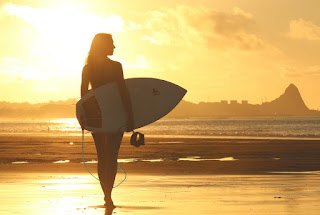
Surf training is one of the best ways to improve your surfing skills out of the sea. Maybe you don’t have time to go to the sea because you are a busy person, and days are too short for you to go surfing. Maybe you live far from the sea and you don’t have the opportunity to go surfing as much as you want… There are plenty of reasons that can prevent you from doing your surf training, what can affect your physical fitness and your skills on the surfboard. Here, we present a series of physical activities that will help you to be fit. This training is design to be done in two days in the gym and one or two days outside (this is something optional). All the activities proposed are really basic and they include a visual explanation as well as pieces of advice. The main goal of this Surf Training is to improve the rowing, increase the duration of the surf sessions, be more powerful and improve the movements related to surf maneuvers. Training PDF ·       -  ...
Physical Benefits of Surfing

Image
As well as relaxing, surfing is an activity that combines aerobic and strengthening work. We have to row against the waves in the sea, so the cardiorespiratory function is improved, calories are burnt and the muscles in our arms and back work. Moreover, surfing is an activity that strengthen our legs, gluteus and core, which is the middle part of our body. In the core, there are plenty of postural muscles which are used in order to stand in the surfboard while skipping the waves.  Benefits Surfing for Life PDF Surfing may be risky, but it’s worth it. Surfing gives us the opportunity of experience an incredible moment on the board, something magical that everyone should live. Besides, surfing has beneficial effects in our muscles which are evident in a short term. We have to jump the big waves and stand in the surfboard; swim and stroke until we get the exact moment to stop, what gives us resistance, strength and improves coordination and equilibrium. 

Basic surf moves

Image
If you want to learn how surfing, you should know the basic moves: ·          Take off:  It is the major skill a surfer hones in his first years of riding, as it is the first surf move. Take of is the moment where the surfer stops rowing and stands in the surfboard. ·           Bottom turn:  This move is the first turn after the take off. ·          Cut back:  It is a 180 ° turn that has to be done once the surfer has moved along the wall of the wave escaping from the shoal in order to come back to the wave. ·          Reentry: This movement consists on climbing to the crest of the wave and making a sharp turn of 180 degrees, lowering it again. ·          Floater: It consists on navigate through a foam line of a breaking wave. ·    ...

Surf nowadays

Image
At the beginning of the 20th  century, after the prohibition and near disappearance of the surf by the arrival of Scottish and German missionaries in 1821, the practice of tracing waves with wooden boards i s reborn in the beach of Waikiki (Hawaii). Here we can highlight Duke Kahanamoku, known for being the "father of modern surfing". The development of surfing was mainly focused on three places: Hawaii, Australia and California Peru. Until the 1960s, there were a few surfers in these areas. It was the release of the film Gidget (1959) that gave surfing its immense popularity, transforming it from an underground culture to an almost national fashion.

Historical evolution of surfing

Image
Caballito of Totora The first time surfing was mentioned in History was in the 16 th century, by Fray José de Acosta . He was a Spanish anthropologist who made important scientific observations in the field of anthropology and natural sciences. José de Acosta wrote in his Natural and Moral History of the Indies (published in Seville in 1590) that the Indians of Peru were " objects of recreation, as there were plenty of them, and they were knights riding their balsillas and cutting the waves of the brave sea” . The Totora is an aquatic plant that gr o ws in South America. The caballito of Totora is a type of boat made with the leaves and stems of this reed. It is designed to transport a sailor with his gear, and it is used during the marine fishing operations in Peru and in the lacustrine of Bolivia. In addition, in some beaches of the Peruvian coast, like Huanchaco, these boats are also used to wave r iding , as it is done with surf.    Hawaii ...

Hall of fame (BMX)

Image
(photo: http://www.marca.com/juegos-olimpicos/2016/04/23/571b943022601dcd748b45a1.html) Thomas Allier (France) 2000 World Champion 1998 World Champion 4 times European Champion CHAUSSON Anne-Caroline (France) 2008 Olympic Champion 2007 European Champion Christophe Leveque (France) Has been crowned the KING of CHAMPIONS, holding 7 World titles in the highest age/performance classes and another 2 titles in lower age classes, which makes his total: 9 world titles won, up and till this moment. ŠTROMBERGS Māris (Latvia) 2012 Olympic Champion 2008 Olympic Champion 2010 World Champion 2008 World Champion FIELDS Connor (USA) 2016 Olympic Champion PAJÓN Mariana (Colombia) 2016 Olympic Champion 2016 World Champion 2014 World Champion 2012 Olympic Champion 2011 World Champion 2010 World Champion  

Interview with a winner

Image
Jose  Matias Guirado Soler, winner of the Arnold Classic Europe 2015 in the category Classic Bodybuilding up to 1.80m. (instagramphoto of @matisoler89) 26 years Murcia 178cm Competition weight: 83,900 kg Actual weight: 99 kg How did you get into the world of bodybuilding? I've always played soccer, but at 19 I left and I joined the gym just for sport. People told me I had good physique. When I was two, I began to take the training seriously and with 22 years I made my first natural competition. From there I was hooked on this world and decided to seriously prepare to compete in 2014.  How was your 2014? My first championship of the season was the regional de Murcia, where I got 1st place in the category classic. The following championships were interterritorial of Onil and Eusebio Esteban Open, where I got the 1st place in both; and the National Championship of Spain, where I also 4th place in the category classic. What wer...

what you have to wear to ride BMX?

Image
Here we have a slides where you can see all this material. Slides. - Jerseys (photo: http://www.flyracing.com/category/bmx/riderwear/jerseys) - Knee pads (photo: http://www.flyracing.com/product/bmx/riderwear/protection/lite-knee-guards/5352/black) - Helmets (photo: http://www.flyracing.com/product/bmx/riderwear/helmets/werx-rival-mips-helmet/4930/tealorangeblack) - Goggles (photo: http://www.flyracing.com/product/bmx/riderwear/goggles/zone-adult-goggle/4021/blackorange) - Gloves (photo: http://www.flyracing.com/product/bmx/riderwear/gloves/lite-glove/61/blueblackhi-vis) - Pants (photo: http://www.flyracing.com/product/bmx/riderwear/pants/20175-kinetic-mesh-pant/5349/crux-bluewhiteorange) - Shoes (photo: http://www.flyracing.com/product/bmx/riderwear/shoes/talon-ii/5068/white)

Spanish tracks vs supercross bmx tracks

Image
There is a big difference between the circuits that we have in Spain with respect to the rest of Europe, for example in Holland, Belgium, Norway, Italy, etc. and with respect to USA In Spain we do not have circuits that contain the Olympic format with an 8-meter ramp, all ramps of exits less than 5 meters. The rest of Europe is much more advanced in this subject, being able to train the ramp of supercross. In Spain the circuits are much smaller with more closed curves and the deepest jumps. Almuñecar (Granada) (photo: track in Almuñecar (Granada): http://www.andaluciaciclismo.com/node/3213 ) Mostoles (Madrid) (photo: track in Mostoles (Madrid): http://pedaleandoporcanarias.com/la-copa-de-espana-de-bmx-hizo-parada-en-mostoles/ ) Mazarrón (Murcia) (photo: track in Mazarrón (Murcia): http://www.primerarecta.es/NOTICIAS_ANTERIORES.html ) In Europe each country at least has a circuit with supercross hill where they can practice. The circuit jumps are much higher and lo...

How to calculate the size of your bike.

Image
Usually this is deduced from the experience of trying several bikes, many years riding, etc. Choosing the size that suits a mountain or road bike is easier than choosing size on a BMX bike. On the mountain bike you just have to be guided by the length of the legs and the total height of the body, but on the bmx bike is much more complex because you have to study your driving style and see what suits you or you like . The size of the bmx bike makes the technique of performing technical gestures much different. For example: to make a manual, it will be much easier with a short distance bicycle between the wheels. The large distance bicycles between wheels are much more stable, for those are used in the Olympic format (exit ramp of 8 meters of altitude ) There is a page that offers help so that the beginner people are not confused of size and can maneuver well with his bicycle. In this page you enter data like the sex and the height and it introduces you in a page where it shows ...

About the world cup in Zolder

Image
(photo: http://www.uci.ch/bmx/ucievents/2017-bmx-uci-bmx-supercross-world-cup/457808117/) For fans of the blog and people who are interested in the sport of bmx, last weekend were held in Heusden-Zolder (belgium) rounds 2-3 of the Bmx world cup. This competition presents a new format with respect to the last year in which it competes the two days (Saturday and Sunday) and does not need to do Time Trial. This year consists of 2 qualifying rounds called Round 1 and Last Chance, in which from there you start to compete the 1/32 final (where the first 4 pass to the next round.) So in succession until the best runners in the world They reach the grand final.It competes in the Olympic format, from an 8 meter exit ramp.You can only register in the competition if you belong to the national team of your country. For see the guide  CLICK HERE! Alejandro Alcojor the athlete mentioned in other posts, belonging to the Spanish national team was there as the only Spanish male representati...

Stay strong on the climb!

Image
One of our most experienced athletes, Javier Román, continues his recovery of wrist, which suffered a sprain last February. According to him: "I am working hard to be the same again and able to compete at my highest level." Strength training on the arms, forearms, wrists and hands will be critical to gain endurance at the final moments of the test and not run out of power in the last few steps. "Preparing for climbing is always tough, if you can be at an elite level," says Javier in his own words, but what is not hard when it comes to professional sports? We all know the demand in this sport, and now Javier is confirming it since the trainings are being a little more monotonous than usual, especially strength, but we are also visualizing techniques and tactics; Will be a hard road to recovery.

TYPES OF SPRINTS IN BMX

Image
TYPES OF SPRINTS to include in your BMX training ACCELERATION SPRINTS:  It is a type of training based on performing sprints with an external resistance or load that hampers that race (hence the adjective of weathered). The methods most used in this type of training are bigger gears, parachutes, races on inclined surfaces (slopes) or drag a companion on top of the bike with rubber band.  Intensity 100%. 5-10 reps. 3-5 minutes rest. It is recommended not to lose more than 10% of the maximum speed without any resistance method to get as far away as possible from the technique of technical gesture.  For the realization of this type of sprints one of the methods mentioned above is used during a short distance (of between 20-40 meters).  Special emphasis is placed on the first 3 pedals, performing three hip extensions (arriving with the body as far forward as possible)  MOTOR RESPONSE SPRINTS:  (The same load that the sport gesture because ...

How to do a skills session in the track

Image
(photo:https://gouache-design.ru/bmx-racing-pictures.php) Let's explain how to do a good technique session on the bmx circuit 1 - First and foremost a good general warm-up (without a bicycle). Mobility of joints and dynamic stretching. We focus on those parts of the body that are directly related to the sport to practice. This will increase body temperature and pulse rate. We will finish the general part with skipping, changes of pace, changes of direction, and progressions. 2 - Specific heating (with bicycle) Run the circuit at slow speed for 2 or 3 turns. Go performing technical gestures from less to greater difficulty. Perform simple technical gestures during short periods of time, but at maximum speed 3 - Perform 7-8 repetitions of technical gestures of great difficulty, such as taps, manuals, manual jumps, manual pick ups, etc. 4 - Finish performing a BIKE game with one or more opponents, increasing the level

Example of strength session SEASON (BMX)

Image
(photo: https://powerexplosive.com/mas-rapido-o-mas-fuerte-optimiza-tu-maxima-potencia-midiendo-el-salto-con-tu-iphone/) This gym session is oriented to the sport of bmx. We must locate it in season, in the mesocycle of realization if it is a model of ATR or in the competitive period if it is a model of classic periodization. We would meet in a Power Strength session In this session between competitions or close to the competition, more specific movements of the sport will predominate, in which, unlike the preseason sessions, the volume will be reduced and the intensity increased. These are fairly extensive sessions in which we seek to mobilize the weights quickly and explosively. The technical gestures when they are practiced in the sport modality are realized of explosive form, having to move just as fast the weights in the gym Specific exercises are used such as the 90º squat or small step, power clean or hang clean, plyometrics and explosive arm push-ups. These multi-artic...